In Pembroke Pines, school board tackles fees, closures, falling enrollment
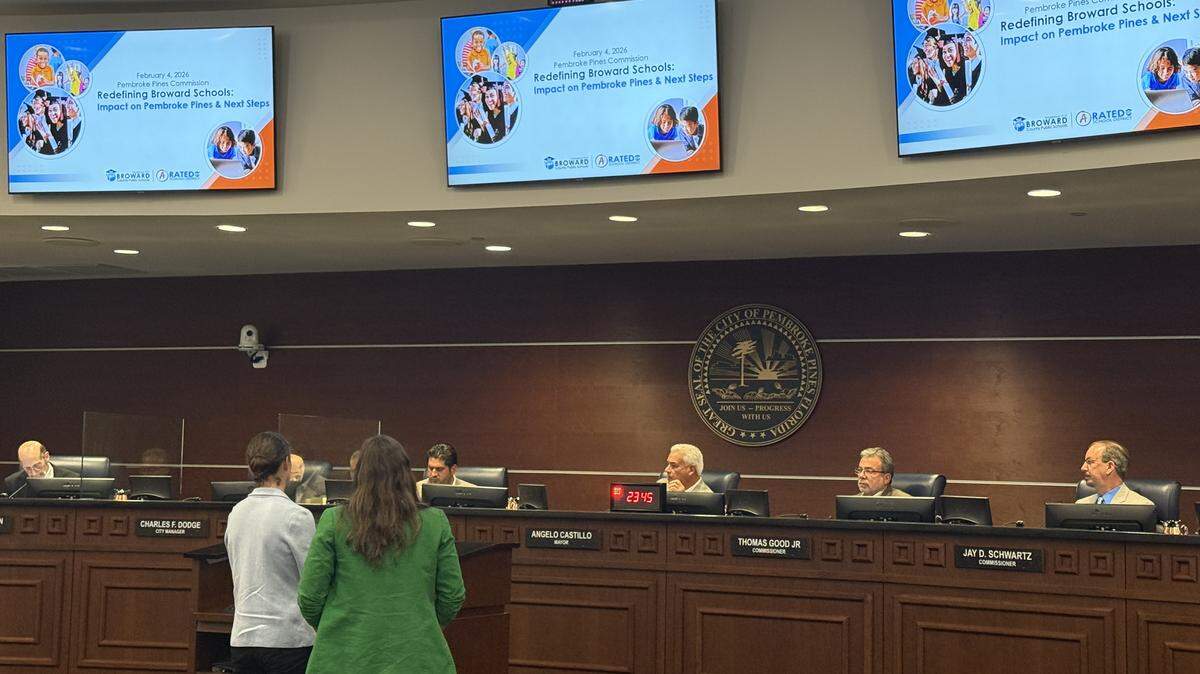
The Pembroke Pines City Commission met Wednesday, Feb. 4, and had a visit from members of the Broward County Public School Board, who talked about the district’s Redefining Our Schools initiative, its impact on the city and a previously adopted resolution tied to student station fees.
A joint discussion between commissioners and school board members centered on mitigating declining enrollment, future use of school facilities and a city resolution that passed late last year that questions the legality of student station mitigation fees under recently changed state law.
Student station fees
The resolution, adopted by the commission on Dec. 11, takes issue with an existing “Education Mitigation Tri-Party Interlocal Agreement” between the city, Broward County and Broward County Public Schools.
The agreement requires the city or future developers to pay a “student station fee” on certain development projects. The fees were created when Broward County schools were experiencing overcrowding and intended to help fund school capacity needs.
The city entered into the agreement as one of nine Broward municipalities to do so.
“The agreement that was signed back in 2004 and 2006 and amended in 2018, was entered into in good faith at the time, but times have changed,” city attorney Sam Goren said. “The statue changed in Tallahassee and so did the (attorney general’s) position on how to approach the issue with fees and expenses.”
During the 2025 Florida Legislative Session, lawmakers passed a bill that amended state concurrency laws to prohibit school districts from enforcing student station fees in addition to impact fees unless those charges meet “rational nexus” requirements. Meaning, that there must be a connection shown between the need for new student stations and new developments.
Commissioner Maria Rodriguez said confusion stems from whether the fees the city are paying are being allocated for new schools or as debt service for schools that were already built.
School board members acknowledged the uncertainty and said the district is awaiting further legal guidance from counsel.
“I too am confused,” District 1 board member Maura Bulman said. “We’re waiting to get a more concrete opinion from our lawyers because the position that the school board attorney is taking is that, some of these fees were our debt service that they were allotted.”
‘Redefining our Schools’
District 2 school board member Rebecca Thompson provided an update on the district’s “Redefining Our Schools” initiative and bid for future partnership opportunities between the two agencies.
“District 2 was the most impacted district in all of redefining,”said Thompson, who represents Pembroke Pines. “Over the last 10 years, we’ve lost about 50,000 students, which obviously equates the money.”
The district’s final vote on the initiative was approved on Jan. 21 and includes school closures, consolidations and boundary changes across the county due to declining enrollment and mounting budget pressures.
In Pembroke Pines, the plan calls for the closure of Panther Run Elementary and Palm Cove Elementary.
Panther Run will be consolidated into Chapel Trail Elementary and Silver Palms Elementary, while Palm Cove will be consolidated into Pines Lakes Elementary and Lakeside Elementary.
Additional changes approved include shifting the portion of the Walter C. Young Middle School boundary west of I-75 to Silver Trail Middle School beginning with the 2026-2027 school year. A similar boundary shift will move students west of I-75 from Charles W. Flanagan High School to West Broward High.
Dr. Valerie Wanza, the school board’s Chief Strategy and Innovation Officer, spoke on the planned transitions of both schools, which are slated for “another district use.”
“The one thing we will not do is have two buildings sitting empty in neighborhoods,” Wanza said as the district works to make sure that future uses for the closed campuses involve community partnerships.
Thompson noted that City Manager Charles Dodge had expressed interest in potential partnerships, including opportunities involving Pines Lakes Elementary and the city’s Senior Center.
Discussion later turned to the future of Walter C. Young Middle, which is owned by the city and leased to Broward County Public Schools.
“Nothing passed to close Walter C. Young,” Thompson said. “However, when meeting with the community, discussions were had about creating Flanagan to be a 6-12, which would open up Walter C. Young to either return it back to the city or ... creating Walter C. Young to be a technical campus.”
Mayor Angelo Castillo pushed back on discussing potential plans: “I’m loath to discuss the future of any of these facilities until you all make the decision that there’s surplus because it inevitably sends the wrong signal to the community.”
Rodriguez said she would be open to future conversations about trade or technical education as the community has expressed interest to her, but said that any partnership would need to make financial sense for the city.
Up next
The next city commission meeting is scheduled for Wednesday, Feb. 18, at 6:30 p.m. Residents may attend in person or watch the livestream through the city’s YouTube channel.